Thứ Hai, 25 tháng 7, 2016

When Marc Gorlin launched his firm Roadie, he knew Georgia was the ideal place to find the talent he needed to launch his on-demand app. Gorlin, who previously co-founded the financing company Kabbage, says the attractive cost of living in the state and access to "smart, talented people in multiple industries" make it attractive.
Abundant financing has also helped. His company, which lets consumers ship goods in the cars of people who happen to be driving to the intended destination, raised $15 million in venture capital in a Series B round in June that included Eric Schmidt's angel group TomorrowVentures.
Small business owner
Thomas Barwich | Getty Images
Georgia is among many states that are working hard to lure businesses of all sizes — and entice them to stay put.
The state, which finishes eighth overall in this year's America's Top States for Business rankings, also notches an impressive sixth-place finish in our Access to Capital category. Not only did Georgia businesses attract $837 million in venture capital financing last year but the state is also in the top 10 for small-business lending, according to 2013 figures from the U.S. Small Business Administration.
There's no one set formula that makes a state business-friendly, say business owners and experts. Rather, it is a mix of ingredients that, when combined, make a state an attractive place to set up shop.
Some states that look unfriendly to business on paper are actually doing quite well in attracting firms of all sizes. For instance, Californiahas a high cost of doing business — the second highest in the nation based on our study — thanks in part to strict environmental and labor regulations. It can also be an expensive place for workers to live, given high housing prices. Its 13.3 percent state income tax is the highest in the country, according to the Tax Foundation. Nonetheless, the state is home to thriving start-up hubs in Silicon Valley and San Francisco. California finishes 32nd in our study overall yet manages second-place finishes for Technology and Innovation and Access to Capital.
"If you talk with businesspeople, they'll say California doesn't have a particularly friendly business climate, but at the same time, it's still a huge economy, and there are a lot of really good companies out there," said Bob LaBombard, CEO of GradStaff, a Minneapolis, Minnesota-based staffing firm. "A lot of those economic factors outweigh the regulatory climate there."
At the same time, states with generous incentives and tax breaks are sometimes less appealing to business than they seem.
"Often, but not always, the states that offer the more aggressive incentives have to for some reason," said Katie Culp, the Indianapolis-based president of KSM Location Advisors, a firm that advises clients about economic development incentives, location analysis and economic development opportunities in 48 states. "They could be lacking in good infrastructure or in large or qualified labor pools. They need to offset some of the negatives on the checklist."
Plus, some incentive programs are hard to tap into because they are so complex, according to Culp. Some packages offered in South Carolinaand Tennessee "look tremendous," said Culp, "but when you dig into the details, there are a lot of caveats that limit the companies' ability to take full advantage of some of those programs."
Here are five important factors that make states attractive to business, according to experts and entrepreneurs.
Students walks past the entrance of Brigham Young University in Provo, Utah.
George Frey | Getty Images
Vibrant college towns. States that are home to cities with a strong university network — and a lifestyle that makes college graduates want to stay  have an edge in attracting businesses that need talent, said LaBombard.
California fares well in this regard, he said. "Los Angeles and San Francisco are go-to cities for college grads," he added, pointing to Texas as another example: "Austin and Dallas are very vibrant." That shows up in our Workforce category, where Texas finishes in eighth place — a major factor in the Lone Star State's No.2 overall ranking.
Utah's abundant talent pool of recent college graduates helped lure Nate Quigley to Provo three years ago to co-found Chatbooks, a site where users can create photobooks, with his wife, Vanessa. He moved from the Melbourne, Florida, area, where he launched his last start-up. With one of the most educated workforces in the nation based on U.S. Census data, Utah finished 12th for Workforce in our ranking.
Salt Lake City is home to universities such as University of Utah, while Provo is home to Brigham Young University and Provo College. "That just fills the state with lots of great talent," said Quigley.
As a result, Quigley has been able to staff up quickly to 30 full-time employees and 40 part-timers. The company hit $5.9 million in revenue in 2015, he said.
Some states have created formal initiatives to connect local universities to employers. In Georgia, for instance, the High Demand Career Initiative, launched under Gov. Nathan Deal, connects Georgia's public university system and the Technical College System of Georgia so educators can hear from the private sector about what skill and degrees are needed. That way, they can create relevant programs, said Chris Carr, commissioner of the Georgia Department of Economic Development.
After finding out from the state's burgeoning film industry that there was a need for trained crew members, the state created the Georgia Film Academy to train workers with production skills in January 2015. "We've had 15 different companies locate in our state since 2011," said Carr.
Abundant financing. Although venture capital deal-making has slowed down, states such as California — which led the country in total venture capital invested in 2015, according to the Moneytree Report by PricewaterhouseCoopers and the National Venture Capital Association — have an edge because of their vibrant investing scenes. So do New York, No. 2, and Massachusetts, No. 3. In terms of small-business lending — the other key element in our Access to Capital rankings — California is tops in overall dollars, and it is in the top third in terms of funds per employee.
States with smaller entrepreneurship hubs also have an advantage. This is especially true in Colorado, where Boulder has an active investing scene, and Utah, where investors are abundant, thanks to the start-up culture in cities such as Salt Lake City and Provo.
One draw for Quigley in launching Chatbooks in Provo was the lively venture capital scene in Utah. His firm has raised $8 million in seed and venture funding — $2 million from two local institutional seed-stage investors, and $6 million from Signal Peak Ventures, a venture capital firm based in Salt Lake City. Utah businesses attracted $732 million in venture capital last year.
"That's what I love about Utah," said Quigley. "We're able to attract the financing we needed to grow the company all right here in Utah."
Low taxes. States that lower the tax burden on companies and individuals have a definite edge in attracting businesses, say experts.It's one of the things we consider in our Cost of Doing Business category, with the help of analysis from the Tax Foundation.
For 2016 the top 10 states with the most business-friendly tax climate,according to the Tax Foundation, were, starting with the best:
  1. Wyoming
  2. South Dakota
  3. Alaska
  4. Florida
  5. Nevada
  6. Montana
  7. New Hampshire
  8. Indiana
  9. Utah
  10. Texas
Texas has attracted many corporate relocations because of its tax climate, noted Holland O'Neil, chair of the board of directors at Gardere, a law firm based in Dallas. The state — the second-biggest state economy in the United States after California — doesn't have a corporate income tax, state property taxes or individual income taxes, O'Neil said, adding, "Texas is very attractive for business."
Among the relocations are Toyota, which plans to establish its headquarters in Plano and move workers from locations in California,Kentucky and New York by early 2017, for instance. Meanwhile, Liberty Mutual Insurance, based in Boston, expects to open a campus in Plano in 2017.
Some states are competing for the most favorable tax climate. Carr of the Georgia Department of Economic Development noted that Georgia eliminated the state's sales tax on energy use in manufacturing to bring new growth to that industry. "We've seen a real resurgence in manufacturing as a result," he said.
Becky Sturm, founder and president of StormSister Spatique
Source: StormSister Spatique.
Becky Sturm, founder and president of StormSister Spatique
Support for Main Street businesses. Becky Sturm has moved around the United States, but when she decided to open StormSister Spatique in 2005, a business that sells beauty products, like her own vegan lipstick brand, she had no doubt that her home state of Minnesota was the ideal location. She sells her wares through an e-commerce store and pop-up retail.
"They really took the shop local and shop small movement to heart," said Sturm. And it's not just government and larger businesses that are supportive of small firms, she said. "The shop local movement is really strong here with consumers."
Tapping into that energy, Sturm has co-founded a pop-up market called The HAMMS Event, short for Help a Minnesota Maker Succeed, which just took place in June. She also founded Lower Town Pop, a market held in Union Depot in downtown St. Paul, an event that gets some city and state support that helps with marketing. "They were looking for someone to host markets or events," she said. "I pitched my idea to them, and they loved it."
Even better, she has found there is money flowing to small businesses like her own. When Sturm needed funding, she was able to find two local investors. "There is a lot of VC money here in the Twin Cities," she said. With one employee other than herself, her business now brings in between $150,000 and $200,000 per year, she claims. Minnesota — last year's Top State — ranks fourth overall this year and 21st for Access to Capital.
StormSister Spatique lipsticks on display.
Source: StormSister Spatique | Facebook
Easy transportation. States need to have an up-to-date, well-maintained transportation infrastructure — including well-connected interstates and highways, rail lines, airports and port shipping — to compete in attracting business, according to "Area Development," a publication that covers topics such as site selection and ranks states on their business climate.
Indiana tops our Infrastructure category this year. Its roads and bridges are in excellent shape according to U.S. Department of Transportation data, linking the state known as the Crossroads of America to both the Midwest and Northeast. The state has robust ports on Lake Michigan, and a busy international airport in Indianapolis. Other Top States for infrastructure include Tennessee, Texas, Georgia and Minnesota.
Some states are also recognizing that improving workers' commutes is important to staying competitive — and taking action to improve their trek to work. With Atlanta facing major congestion in some areas, the legislature increased the gas tax, a hike that took effect last July. "We now have an additional $10 million over the next 10 years to address roads, bridges and congestion problems," said Carr. "A lot of states and cities talk about congestion. We are funding the plan and executing on that plan. Our governor and legislature deserve a lot of credit."
Theresa May, the new U.K. Prime Minister, has tried to calm fears over one of the biggest post-Brexit problems, Northern Ireland.
Northern Ireland's border with the Republic of Ireland is one of only two physical borders between the U.K. and another European state (the other is Gibraltar, which has a border with Spain).
Since the 1998 Good Friday Agreement bought peace to the region, border controls were lifted, made possible in part by both states' EU membership. As a result Northern Ireland's relationship with the Republic has strengthened and its economic development has been boosted by EU funding for farming, fishing and infrastructure.

A majority of people in Northern Ireland (56 per cent) voted to remain in the EU in the June 23 referendum, compared to a 52-48 percent split in favor of leaving in the overall U.K. vote. The nationalist community overwhelmingly backed staying in the EU, and Deputy First Minister Martin McGuinness of Sinn Fein, the country's largest nationalist party, called for a vote on a united Ireland in the wake of the Brexit vote.
On Monday, several prominent Northern Irish politicians threatened a legal challenge to Brexit, which is unlikely to happen in the next couple of years, because of the complexities involved. They pointed out in a statement "the unique requirements of Northern Ireland constitutional law and statute, in particular the statutory recognition of the Belfast-Good Friday Agreement".
May said in a statement: "I have been clear that we will make a success of the UK's departure from the European Union. That means it must work for Northern Ireland too, including in relation to the border with the Republic."
She will meet Enda Kenny, Taoiseach of Ireland, in London on Tuesday. Kenny has also expressed his government's commitment to maintaining an open border with the North.
1469135405_tech_nianic31-1Over the past couple of weeks, the smartphone game Pokémon Go has more than doubled Nintendo’s share price and reintroduced the Pokémon Co.’s digital monsters to the mainstream. The game’s developer, which released it in partnership with those companies, is a relative unknown.
Niantic, a San Francisco startup with fewer than 100 employees, developed Pokémon Goand the mapping technology that allows the game to layer digital creatures over real-world environs. Mapping has long been a specialty for Chief Executive Officer John Hanke, who helped lay the groundwork for Google Earth with his previous company, which the search giant acquired in 2004. Hanke, a lifelong gamer, made game-world mapping of the real world his focus when he launched Niantic as a startup within Google six years ago. Niantic spun off on its own last year, though Google remains an investor, alongside Nintendo and the Pokémon Co.
In Ingress, the playing field is based on real geography and landmarks that players battle to control.
In Ingress, the playing field is based on real geography and landmarks that players battle to control.
 
Source: YouTube
“It’s great to be an armchair traveler with Google Earth, but my mind turned to how you could transfer that experience to mobile to make it easier to discover new places,” Hanke says. By using the locational tracking built into players’ phones to encourage them to congregate in certain places to look for Pokémon, Niantic is prying gamers off their couches. “Our intent,” he says, “was that people would become aware of their surroundings, accidentally.”
Niantic’s first game, Ingress, released in 2012, used similar mapping mechanics with more sci-fi flavor. Players would pick one of two teams that met up at real-world landmarks to capture or defend them, like a building-centric version of Capture the Flag. The free game has been a modest hit, with 1 million active users.
Pokémon Go’s success is on another level. It’s been one of the most popular downloads on iOS and Android since its release, and by some analysts’ estimates it has been downloaded more than 20 million times. It runs on a freemium model—no charge to play, but players will have an easier time if they pay a couple of bucks for virtual items that help them advance.
In Pokémon Go, players must physically travel to landmarks, called PokéStops, to collect items and capture creatures. Here, a player stands between two PokéStops and three monsters in Madison Square Park.
In Pokémon Go, players must physically travel to landmarks, called PokéStops, to collect items and capture creatures. Here, a player stands between two PokéStops and three monsters in Madison Square Park.
 
Source: YouTube
Hanke says Niantic also plans to sell sponsorships, allowing stores to pay to become PokéStops, where players can gather items, to boost their foot traffic. During the game’s first weekend, on July 9-10, “it blew up,” says Jeff Pray, senior vice president at marketing agency Starcom MediaVest Group. “It was the No. 1 topic at my Monday meetings.” Piper Jaffray analyst Michael Olson says Niantic has created a gaming genre and that other companies will soon follow with copycat games featuring popular existing characters.
Popularity doesn’t necessarily mean longevity. Pokémon Go drains a lot of battery power and won’t be much fun in cold weather, says Wedbush Securities analyst Michael Pachter. He compares the game to Draw Something, a megahit app that also notched 20 million downloads in a few weeks during 2012, but has since been dismissed as a fad. “People just got bored” with it, says Pachter.
Winters in New England can be brutal, so Ernie Boch Jr., heir to a billion-dollar car dealership fortune and proud Boston resident, came up with a fairly straightforward solution: When it snows, he leaves.
Ernie Boch Jr.'s home on Nevis, which has views of the ocean.
 
Photographer: Xynn Tii
A decade ago, after a drawn-out search for a winter house in the sun (Florida, the Texas panhandle, and a few Caribbean islands were nixed), Boch purchased a property on the tiny island of Nevis, which is about a 45-minute ferry ride from the larger St. Kitts. “The second I stepped off the boat, I realized it was the place to be,” he said, noting that it’s “off the beaten path— a very mellow island.”
The house is part of the Four Seasons Resort Estates compound on the island.
 
Photographer: Xynn Tii
After a recent divorce, though, Boch is looking for a change and has duly listed his five-bedroom, six-and-a-half-bath house for $7.2 million. “My girlfriend and I, we’re going to start new,” he said. “We might buy somewhere else on the island.”
The house has five bedrooms.
 
Photographer: Xynn Tii
The current house, though, has the privileged position of being part of the “Four Seasons Resorts Estates” compound, which entails paying an annual fee of what Boch said is around $40,000. In return, Boch has access to the island’s Four Seasons Hotel’s amenities, including an optional, in-home private chef, access to the hotel beach, and year-round property maintenance.
Every room opens onto a veranda.
The house, which has 4,240 square feet spread across two floors (there’s also a small guest cottage), is set into the hillside and oriented toward a sea view. There are massive verandas, onto which every room in the house opens, and a large, open-plan entertaining room on the upper level. Boch decorated the house with the help of the Boston-based interior designer Anthony Catalfano in what he called a “traditional British West Indies style, with a bit of an Asian flair,” and oversaw the installation of a Crestron “total home control system,” which allows Boch to access his lighting, climate control, and sound system remotely with his iPhone. “If I burn a CD in Boston, it’s immediately populated into my system in Nevis,” he said. “The features are very modern.”
The pool, which Boch specified be twice as large as normal.
 
Photographer: Xynn Tii
Outside are a massive pool (“it’s twice as big as normal,” Boch said), a hot tub, an outdoor kitchen, and a grassy lawn. The house is about a 10-minute drive into Charlestown, the main town on the island, and a 5-minute golf-car ride to the beach.
The kitchen.
The kitchen.
 
Photographer: Xynn Tii
Boch says that he can get from his house in South Boston to his house in Nevis in less than four and a half hours, a trip eased, somewhat, by his private jet. For potential buyers stuck flying commercial, the trip takes a bit longer— travelers have to fly into St. Kitts, then take one of six ferries.
A view of the interior.
 
Photographer: Xynn Tii
The hassle might be worth it: Anyone who owns a home on Nevis automatically qualifies for citizenship, which, along with visa-free travel to 120 countries, entails no direct personal taxes. Permanent residency might have its drawbacks, though: “Nevis is on the hurricane belt, so they hit the island quite often,” Boch said, noting that his house is rarely affected because it’s nested in the mountains.
A bathroom in the house.
President Ashraf Ghani’s claim four months ago to have wiped out Islamic State in Afghanistan was shattered Saturday when the militant group struck the capital, Kabul, the country’s deadliest attack in 15 years of war.
More than 80 people were killed and another 231 were wounded when suicide bombers triggered two explosions at a rally by hundreds of ethnic Hazaras on Saturday, according to an e-mailed statement via the Afghanistan Interior Ministry. A third bomber was shot dead by police before detonating an explosive vest.
“The attacks by ISIS reveal how far the group has gone beyond its bases in the eastern region," Ahmad Saeedi, a former Afghan diplomat in Pakistan, said by phone. “The U.S., Afghanistan and international community must go after them to destroy these new wolves before they destroy us."
The Islamic State’s ability to carry out deadly attacks complicates prospects for peace in Afghanistan, where Afghan and U.S. forces and their allies have fought Taliban insurgents since 2001. In a rare move, the Taliban joined the government in condemning the attack by ISIS, a group it considers mostly “well-known robbers and kidnappers" with no connection to Afghanistan. 
The protesters, who were mostly Shiite Muslims in Sunni-majority Afghanistan, were rallying against government plans to divert a planned regional power line away from the Hazara-dominated province of Bamiyan. Islamic State claimed the assault as a “martyrdom attack” on Shiites, according to a statement on the Amaq News Agency website.

Troop Withdrawal

The carnage is the single deadliest assault in the country since 2001, the year the U.S. invasion unleashed the Taliban insurgency, according to the United Nations Assistance Mission of Afghanistan. It marks the first time Islamic State has struck the Afghan capital since gaining a foothold in the country in 2014, and has stoked fears the extremists are gathering strength.
The attack was condemned around the world, including by both the White House and Russian President Vladimir Putin, who said his country stood ready to help Afghanistan fight terrorism.
President Barack Obama, who once promised to pull out all U.S. combat troops from Afghanistan within 16 months of taking office, last October said he would slow thewithdrawal from the country, leaving about 8,400 military personnel at the end of this year.
Last month Obama expanded the U.S. mission to allow troops to deploy alongside their Afghan counterparts in the fight against the Taliban and other insurgent groups in an acknowledgment that nation-building efforts and peace negotiations have foundered.
A four-nation peace process led by Pakistan this year failed to make any headway after the Taliban refused to join negotiations. The 15-year conflict has cost the U.S. almost $700 billion and killed more than 2,200 American troops.

Taliban Clashes

The Taliban condemned Saturday’s attacks, calling them an attempt by Islamic State to ignite civil war, according to an e-mailed statement from spokesman Zabihullah Mujahed.
The two groups have clashed as they compete for territory in the east, leaving scores dead. Islamic State, which includes disaffected Taliban fighters from Pakistan and Afghanistan, now ranks behind the Taliban and al-Qaeda in the country, with as many as 3,000 fighters, according to a U.S. Congressional Research Service report.
In March, President Ghani declared on national television that after months of fighting in remote districts of Nangarhar near the Pakistani border, Islamic State in Afghanistan had been wiped out.
“This deadly attack was a retaliation by Daesh, who have taken a beating in recent months from our Afghan forces and American drone strikes,” Naimatullah Ghafari, a member of Afghanistan’s Parliament, said by phone, using the Arabic acronym for the group. “Unfortunately Afghan civilians always pay the price in this war.”
1469046759_High Court View 2
Imagine you are working. You are stressed. You are bombarded by e-mails, phone calls, life. For many, this is everyday reality, but for the select few, an alternate universe is being constructed for your daily escape. 

Instead of crawling under your desk and waiting for 5 p.m. to come, imagine you walk into a members-only, 6,000-square-foot sanctuary filled with limitless yoga classes, cold-pressed juices, and the smells of sage and palo santo wood wafting through the air. You head to the locker room, placing your bare feet on the terrazzo floor and your belongings in a locker made with sustainable northeastern wood. Pad over to the yoga studio and take a child's pose on your eco-friendly byVivid yoga mat as other members—but never more than 20—trickle in. Afterward, you wrap yourself in a Turkish robe and maybe take in a lecture on crystal healing. On your way out, you can even pick up some of Gwyneth Paltrow's favorite Brain Dust at the in-house store. 

Ah. Bliss. But for a price.
This mix of wellness, luxury, and exclusivity will soon be available to New Yorkers at the inaugural location of High Court in lower Manhattan. Described by its co-founders, sisters Colleen and Hailey Brooks, as “the third personal space, after home and office,” it will be the place where “intelligent leisure” reigns. The first of what they hope will be a chain, High Court aims to be less a gym and more a haven, built with the same combination of mindful living and high-end taste that Paltrow famously used to build an audience for her website, GOOP. (Though the sisters follow some of the actor's cues, she isn't associated with the company.)
At High Court, working is relegated to specific designated areas, and the members are all “young, ambitious and curious.” Hoping to tap into several segments of the estimated $3.4 trillion wellness industry (PDF), including fitness, healthy eating, and beauty, the sisters see the $250-per-month price tag—plus food, drink, and gear from the store—not as a replacement for Equinox memberships (around $200+ in New York, depending on location) or SoulCycle classes ($34 each). Rather, they see it as an addition: part of a health-minded millennial’s “portfolio of memberships,” as Hailey describes it.
“It’s not just a yoga studio with a living room,” Hailey, who comes from retail buying, said. “You’re signing up for a new kind of social house.”
“From a trendcasting perspective, it’s a really good idea,” said Liz Dennery, founder and chief executive officer of SheBrand, a Los Angeles-based branding and marketing firm. She cited the growing group of professionals who prioritize their health and well-being over other aspects of their busy lives. While she lauds High Court for offering the human element that's largely lacking in the current Internet-based wellness community, she also advises more social media engagement: the High Court Instagram account has only 3,600 followers compared with such private clubs as Soho House and its 108,000 followers or GOOP, with 419,000. “They should absolutely reach out to high profile yoga teachers, nutritionists, and celebrity influencers in New York,” Dennery said. 
Then there's the private club allure to go along with the earthy-crunchy atmosphere. Colleen, who spent the last nine years working in finance, points out that socializing has always cost money, but comes with fewer benefits. “I would always be, ‘let’s go out to dinner, let’s catch up, and I’d walk away having spent fifty to a hundred dollars,’” she said, recalling an experience familiar to most professional urbanites. “I would feel unhealthy all the time and it would be condensed to an hour or an hour and a half at that dinner table and then you’re rushed out.” At High Court, catching up will be easier and healthier, the sisters say. Unlike a gym, its members can bring up to two friends with them every time they visit.
Like the Soho House-model (but with less alcohol and sunbathing) or venues such as NeueHouse (without the focus on work), High Court will curate everything from its towels to its members. But while a $2,800 per year Soho House membership buys global access, as does an extra $50 on top of NeueHouse's New York full access price of $1,500 per month, High Court can't offer the same until new locations are built. 
But before you start mulling your options, you have to get in. And at High Court, admission is decidedly not guaranteed. The application requires divulging your age, gender, zip code, profession, and (gasp) Instagram account. Next come meetings with one or both of the Brooks sisters. They say that members will be chosen with an eye toward maintaining gender balance and diversity. “Like seating a dinner party,” Hailey said. 
After hosting its preview pop-up experience in Tribeca earlier this month, the founders say they've already received more applications than the 200 spots allotted for first comers. Before the event, they had raised about half of their $3 million funding goal, with more potential investors lined up. They are finalizing their lease for a space at the corner of Nassau and Fulton Streets, planned as the first of five over the next five years, with two more planned for Manhattan before an expansion to Austin and Los Angeles.
Rendering of High Court's planned space in downtown Manhattan. 
“In the hustle and bustle of a crazy New York life, people do want an escape,” said Jamie Krell, a lifestyle editor and media personality. While gyms are a good place to exercise, they are not built for relaxation. “You’re signing up for SoulCycle and getting blocked out, it can add more stress.” 
Not everyone, however, is on board with this brand of self care. “I like that it’s making us think about our health and a preventative approach,” said Timothy Caulfield, a professor in the Faculty of Law and the School of Public Health at the University of Alberta (and author of Is Gwyneth Paltrow Wrong About Everything? When Celebrity Culture and Science Clash). “What I don’t like,” he said, “is framing wellness as if it’s a luxury item.” This kind of model, he said, “creates this illusion that you have to do certain things to maximize your health.” Yoga is good for you, he said, but is hardly the only—or best—way to get fit. Such products as the $55 herb-based Brain Dust, are cleverly marketed, unregulated supplements, not clinically proven medicines—and are completely unnecessary for a healthy lifestyle.
The Brooks sisters recognize that some elements may raise eyebrows, and they don’t claim that the $20 Sweet Saba crystal candies available at the pop-up are actually “magical,” as their packaging says. But, asked Hailey, “Aren’t you curious?”
As the world struggles to break out of a prolonged period of sluggish expansion, don’t count on its No. 2 economy to ride to the rescue.
That was the message from China’s Premier Li Keqiang on the eve of a gathering of finance chiefs from the top emerging and developed economies. While China’s contribution to the world will remain large, and serves as a stabilizer, the nation also faces long-term downward pressure, he said Friday at a press conference in Beijing.
"China is still a developing country -- we can’t shoulder the heaviest burden of the world’s economy," Li said after a round-table discussion on economic growth, trade and finance with heads of institutions including the International Monetary Fund. He called for countries around the world to implement "proactive" fiscal policies, as China is doing.
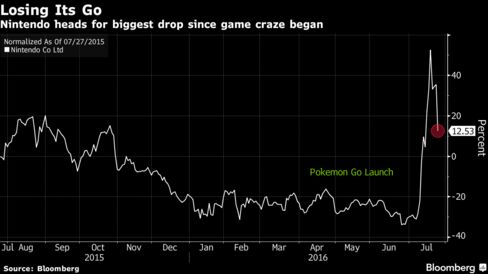
Nintendo Co. shares plunged by the most since 1990 after the company said late Friday that the financial benefits from the worldwide hit Pokemon Go will be limited.
The stock sank 18 percent to 23,220 yen at the close in Tokyo, the maximum one-day move allowed by the exchange, wiping out 708 billion yen ($6.7 billion) in market value. After debuting in the U.S. earlier this month, Pokemon Go launched in Japan on Friday and became available in Hong Kong on Monday.
The correction comes after Pokemon Go’s release almost doubled Nintendo’s stock through Friday’s close, adding $17.6 billion in market capitalization. Nintendo is a shareholder in the game’s developer Niantic Inc. and Pokemon Co., but has an "effective economic stake" of just 13 percent in the app, according to an estimate by Macquarie Securities analyst David Gibson.
“It’s still possible to say that in the short-term it’s overheated,” said Tomoaki Kawasaki, an analyst at Iwai Cosmo Securities Co.
A Syrian gamer uses the Pokemon Go application on his mobile to catch a Pokemon amidst the rubble in the besieged rebel-controlled town of Douma, Syria.
 
Photographer: Sameer Al-Doumy/AFP via Getty Images
In a press release after the market closed on Friday in Japan, the Kyoto-based company said the game’s financial impact will be "limited" and that it is not necessary to revise its annual forecast even after factoring in current conditions. It also said revenue from Pokemon Go Plus, a Nintendo-produced accessory for the game expected to go on sale soon, has already been factored into the current guidance.
“The content of the announcement itself is not that shocking, but it is a surprise they said it on Friday instead of when they report earnings” later this week, said Nobuyuki Fujimoto, a senior market analyst at SBI Securities Co. “The game has been published in Japan, so for the time being we’ve exhausted all the catalysts.”
The company will report first-quarter earnings on Wednesday after the market close, a period which ended before the release of Pokemon Go. The firm is forecasting an annual net profit of 35 billion yen in the current fiscal year, up from the 16.5 billion yen it earned last year.
Short interest in Nintendo surged earlier this month as bears bet the stock rally had gone too far. As of July 20, short-sellers had built up a bet worth $940 million -- or 2.6 percent of outstanding shares -- that the stock would fall, according to researcher IHS Markit. At current prices, such a bet would have generated about $140 million in profits.
Shares of related companies also fell. McDonald’s Holdings Co. (Japan), the game’s exclusive launch partner, declined 12 percent. Electronic parts maker Hosiden Corp., which Mitsubishi UFJ Financial Group Inc. said may produce Pokemon Go Plus, sank 16 percent.
Besides the earnings announcement on Wednesday, Morgan Stanley said the next focus point is if Pokemon Go launches in China, where access to geographical data necessary for the game is restricted by the government. Investors are also waiting for announcements on Nintendo’s other upcoming mobile games and its next-generation console expected to be released next year, analysts Mia Nagasaka and Yuki Maeda wrote in a July 22 report.